Key takeaways:
The Rock Ola 1422 converted to 45rpm enhances compatibility by allowing playback of modern 45rpm records while preserving the jukebox’s original mechanics. Conversion demands precision hardware like gear sets calibrated for 60 Hz motors and requires torque application between 5 and 7 inch-pounds. This upgrade increases functional lifespan and maintains vintage appeal without significant complexity.
Is your vintage jukebox stuck playing only bulky 78rpm records? Modern enthusiasts find that shifting the Rock Ola 1422 to support current vinyl formats is both practical and enriching. The adjustment hinges on correct installation of specific components such as 45rpm gear sets and adapter rings, ensuring smooth operation and sound fidelity. With attention to precise torque and proper tonearm settings, owners can enjoy a lasting, authentic playback experience. Understanding these essential elements unlocks the jukebox’s potential for versatile music enjoyment.
Rock Ola 1422 Converted to 45rpm: Viability
The Rock Ola 1422 converted to 45rpm is a common modification that many jukebox enthusiasts consider to update vintage players for modern vinyl formats. Originally designed for 78rpm records, the 1422 model can be successfully converted to play 45rpm records, making it more versatile without compromising its mechanical integrity. Conversion is particularly viable for those wanting to use more readily available 45rpm singles while preserving the original charm of the jukebox.
This conversion not only improves compatibility with modern collections but also extends the jukebox’s functional lifespan. Given the jukebox’s sturdy build and classic mechanism, a properly done conversion retains the vintage appeal and adds practical value. Conversion requires some specific parts and careful adjustments, but the process isn’t overly complex for someone with basic mechanical skills and familiarity with record players.
Note that the efficiency of the conversion depends on the availability of precise replacement components, such as gear sets and needle assemblies, specifically designed for 45rpm operation. The modification includes speed calibration to ensure that records play at their intended pitch and tempo.
- Allows playing modern 45rpm records
- Preserves the original jukebox mechanics
- Requires specific hardware adaptation
Parts and Hardware for 45rpm Conversion
45rpm Gear Set for 1422 (60 Hz)
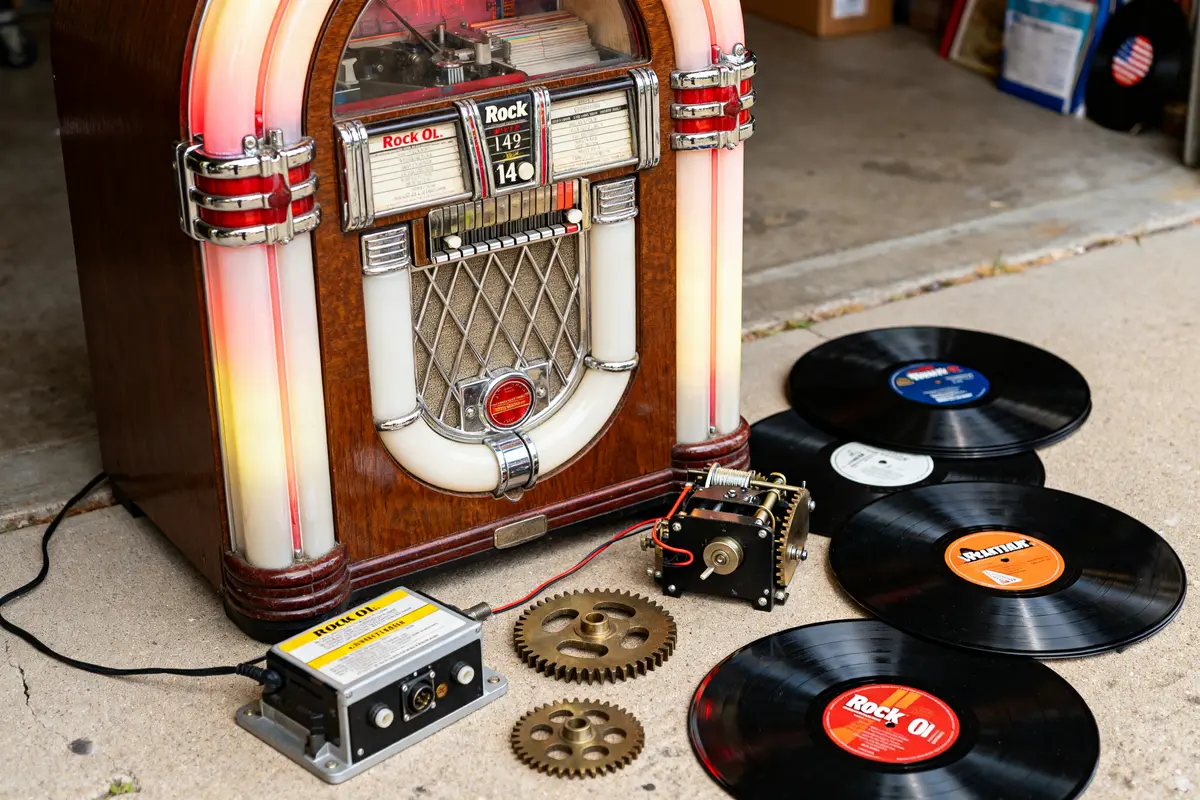
A critical element in the 45rpm conversion of the Rock Ola 1422 is the installation of an exact 45rpm gear set compatible with 60 Hz motors. The gear replaces the original 78rpm drive gear and adjusts the motor speed to the necessary 45rpm. The exact gear teeth count and ratio are essential to achieve accurate speed conversion without motor strain or slippage.
The correct gear set ensures smooth transmission of power and maintains the jukebox’s reliability. Using an incompatible gear set may cause incorrect speeds or increased wear on components. Users often underestimate the importance of precise torque settings when fastening this gear. Applying moderate torque—tight enough to secure but not so tight as to deform the gear—is key to preventing damage during installation.
Typically, the 45rpm gear set designed for the Rock Ola 1422 features a gear ratio that matches the motor’s rotation frequency and belt tension, assuring consistent speed across all records.
45rpm Adapters: Center-Hole Rings and Clips
Since original 78rpm records and 45rpm records have different center holes, converting the Rock Ola 1422 requires appropriate adapter rings and clips to hold 45rpm discs securely on the turntable. The center-hole rings fit over the spindle and reduce the large 45rpm hole to a compatible size for the 1422 tray. Clips are installed to hold the record firmly in place during playback, preventing slipping or wobbling that would otherwise affect sound quality.
Adapter rings must match the turntable dimensions precisely to function correctly. Manufacturers supply these adapters in durable materials, often brass or aluminum, to maintain a balanced turntable rotation. Record trays with pre-installed clips specially designed for 45rpm can also be sourced, offering a plug-and-play solution for enthusiasts who want to avoid custom fitting parts.
Needle and Cartridge Changes for 45rpm
The conversion also calls for changing the cartridge or needle, as 45rpm records use a finer groove than 78s. A cartridge designed for 45rpm typically has a smaller stylus radius, allowing accurate tracking without causing record wear. Using the original 78rpm needle can cause damage to 45s and degrade audio fidelity.
If the jukebox already has an Astatic 51-2 or similar cartridge, replacing the needle alone with a 45rpm-compatible stylus is sufficient. If the cartridge is original or outdated, a full replacement is recommended. This ensures optimal sound reproduction and safeguards the vinyl.
Down-stops and cut-off points must also be adjusted along with the cartridge change, guaranteeing the needle lifts properly at the end of each song selection without scratching the record surface.
Installation Steps for Rock Ola 1422 Converted to 45rpm
Installing the 45rpm gear set and adapters requires careful disassembly of the turntable mechanism. Start by unplugging the jukebox and removing the platter to access the original 78rpm gear. Clean the motor shaft and mount points to remove any grease or debris that might affect gear placement.
When installing the new 45rpm gear, apply a torque between 5 and 7 inch-pounds to the fastening nut. This recommended torque prevents slippage while avoiding over-tightening, which can deform the gear teeth or damage the motor shaft. Always refer to manufacturer specifications for torque accuracy if available.
Next, place the adapter rings and clips onto the record trays, making sure they fit snugly but not too tightly or loosely. Test the movement of the tray to confirm that clips hold firmly without causing friction or obstruction.
Swap out the original cartridge or needle for the 45rpm compatible version, then adjust the tonearm’s vertical and horizontal alignment to fit the new stylus geometry. Don’t forget to reset the down-stop for correct lift and drop operation.
Double-check wiring connections to the motor and cartridge to prevent electrical faults before reassembling the mechanism.
Author’s Note
« When switching from 78rpm to 45rpm on the Rock Ola 1422, precise gear ratio matching is crucial to maintain stable playback pitch and avoid strain on your motor, preventing costly damage. »
Testing, Calibration, and Final Adjustments
Speed Setting, Tracking Weight and Down-Stop
After installation, setting the correct speed is essential to ensure the jukebox plays records at 45rpm precisely. Use a digital stroboscopic speed tuner or a reliable speed calibration disc to fine-tune motor speed. Speed slippage or incorrect gear meshing can cause pitch issues and wear on components.
Adjust the tracking weight to around 3.5 to 4.5 grams for 45rpm records. This tracking force is lower than the typical 78rpm setting and is recommended to minimize record wear while assuring proper stylus contact. Incorrect tracking weights will either cause distortion or record damage.
The down-stop setting controls how the tonearm lifts at the end of a selection. Calibrate this so the arm lifts smoothly without lag or premature cutoff. Testing with multiple 45rpm records of various thicknesses helps confirm correct adjustment.
Tonearm Alignment and Test With 45rpm Records
Proper tonearm alignment is essential to reduce stylus and record wear. Check that the arm tracks true over the groove by visually inspecting the stylus angle and making small horizontal or vertical tweaks. Misalignment causes distortion, skipping, or excessive needle pressure.
Run several 45rpm records through the jukebox, listening closely for any audio irregularities. Confirm the automatic functions such as record lift, return, and cueing respond correctly. Monitor motor noise and turntable rotation for smoothness and stability.
Successful calibration results in clear, stable sound and reliable mechanism operation, blending the jukebox’s classic aesthetics with modern playback capability.
Vendor References and Cost Considerations
When sourcing parts for the Rock Ola 1422 converted to 45rpm, reputable vendors like Victory Glass and specialized jukebox restoration shops provide the necessary gear sets, adapters, and cartridges. Availability of authentic or reproduction parts can vary, so purchasing verified components is essential for compatibility.
Costs for conversion parts usually range between $150 and $400, depending on the quality and completeness of kits. Labor and calibration time, if outsourced, add to the overall expense.
Besides parts, budget for potential cartridge or speaker upgrades to enhance sound. While DIY conversions save labor costs, professional calibration might be advisable for beginners to achieve peak playback fidelity.
- 45rpm gear sets: $120 to $250
- Adapter rings and clips: $30 to $100
- 45rpm cartridges/needles: $40 to $100
By investing carefully in quality components, you both preserve and enhance your jukebox’s value and function.
Ready-to-Use Checklist for 1422 45rpm
- Gather 45rpm gear set designed for 60 Hz motor of 1422
- Acquire center-hole adapter rings and clips for 45rpm records
- Obtain 45rpm-compatible needle or cartridge
- Disassemble turntable and remove 78rpm gear
- Clean motor shaft and mount surfaces
- Install 45rpm gear set with recommended torque (5-7 inch-pounds)
- Install adapter rings and clips on record trays
- Replace cartridge or needle for 45rpm use
- Adjust tonearm tracking weight to 3.5-4.5 grams
- Set down-stop for proper tonearm lift
- Calibrate turntable speed to exact 45rpm
- Test with multiple 45rpm records for sound and mechanical reliability
- Reassemble jukebox and verify all electrical connections
✅ Interactive Checklist for Rock Ola 1422 45rpm Conversion
Select the tasks you have completed to track your jukebox conversion progress.
FAQ: rock ola 1422 converted to 45rpmIs it possible to convert a Rock Ola 1422 to play 45rpm records?
It is possible to convert a Rock Ola 1422 to play 45rpm records by replacing the original 78rpm gear set with a precise 45rpm gear designed for 60 Hz motors, installing adapter rings and clips for 45rpm discs, and changing the needle or cartridge accordingly.
What parts are needed for Rock Ola 1422 45rpm conversion?
Needed parts include a specific 45rpm gear set compatible with the 1422 motor, center-hole adapter rings and clips to secure 45rpm records, and a 45rpm-compatible needle or cartridge to accurately track the finer grooves of 45rpm vinyl.
How do you calibrate and test a Rock Ola 1422 after converting it to 45rpm?
After conversion, calibrate the speed using a digital stroboscopic tuner to ensure precise 45rpm playback, adjust tracking weight to about 3.5 to 4.5 grams, set the down-stop for smooth tonearm lift, and test multiple 45rpm records for clear sound and reliable automatic operation.
What is the cost range for converting a Rock Ola 1422 to 45rpm?
The cost for conversion parts typically ranges from $150 to $400, including the gear set ($120–$250), adapter rings and clips ($30–$100), and cartridges or needles ($40–$100). Additional labor or professional calibration may increase overall expenses.
What are the steps to install a 45rpm gear set on a Rock Ola 1422?
Installation steps include unplugging and disassembling the turntable, cleaning the motor shaft, installing the 45rpm gear set with 5 to 7 inch-pounds torque, fitting adapter rings and clips on trays, replacing the cartridge or needle, adjusting tracking weight and down-stop, and verifying wiring before reassembly.
Why is it important to use specific adapter rings and clips for 45rpm records on the Rock Ola 1422?
Using specific adapter rings and clips is important because 45rpm records have larger center holes than 78rpm discs; these adapters securely hold 45rpm records on the platter, preventing slipping or wobbling, which maintains sound quality and proper playback stability.

John has been passionate about furniture and interior design for over a decade, combining his love for vintage pieces with modern styling techniques. After years of helping friends transform their spaces and restoring countless furniture finds, he started this blog to share his expertise and inspire others to create homes they truly love. When he’s not writing or hunting for unique pieces at estate sales, you’ll find him refinishing a mid-century dresser or experimenting with new room layouts in his own ever-evolving home.