Key takeaways:
The Eastlake furniture style originated from Charles Eastlake’s 1868 publication Hints on Household Taste, promoting simpler, functional designs. By the late 19th century, American manufacturers employed jigsaw cutting and scroll sawing to mass-produce Eastlake pieces, particularly in cities like Grand Rapids, Michigan. Authentic Eastlake dressers commonly measure between 4 to 5 feet tall and emphasize geometric ornaments and spindle work.
Is it possible that a style critical of Victorian excess became a mass production favorite in the United States? Eastlake furnishings blend artistry with industrial techniques, making high-quality design attainable for middle-class American homes. This furniture style thrives on a balance of handcrafted pride and mechanized precision using tools like scroll saws underpinned by durable materials such as oak and walnut. Understanding Eastlake furniture equips owners to recognize authentic craftsmanship and appreciate its role within late 19th-century manufacturing advances.
Eastlake Furniture Origins and Designers
Charles Eastlake and Hints on Household Taste
The Eastlake furniture movement traces back to Charles Eastlake, a British architect and writer who published the influential book Hints on Household Taste in 1868. Eastlake advocated for simpler, well-crafted furniture that combined beauty with function. He was critical of the overly ornate Victorian styles, favoring clean lines and practical designs that were easy to maintain.
Eastlake insisted that furniture should reflect the skill and pride of its maker, whether handcrafted or machine-assisted. His ideas emphasized decorative elements that were subtle rather than extravagant, such as low-relief carvings and linear incisions. This approach marked a significant departure from earlier heavy, cumbersome Victorian pieces.
American Adaptation and Mass Production
The Eastlake style gained tremendous popularity in the United States during the late 19th century. American manufacturers adapted Eastlake’s principles to mass production, making the style accessible to the middle class. Cities like Grand Rapids, Michigan, and New York became hubs for Eastlake furniture factories, where mechanized techniques such as jigsaw cutting and scroll sawing expedited the creation of intricate components.
While Eastlake himself did not approve of mass-produced furniture bearing his name, these industrial techniques allowed for the replication of detailed spindle work and geometric decoration at affordable prices. This democratization of style helped embed Eastlake furniture as a common sight in American homes of the era.
Eastlake Furniture Features and Motifs
Geometric Ornament and Spindle Work
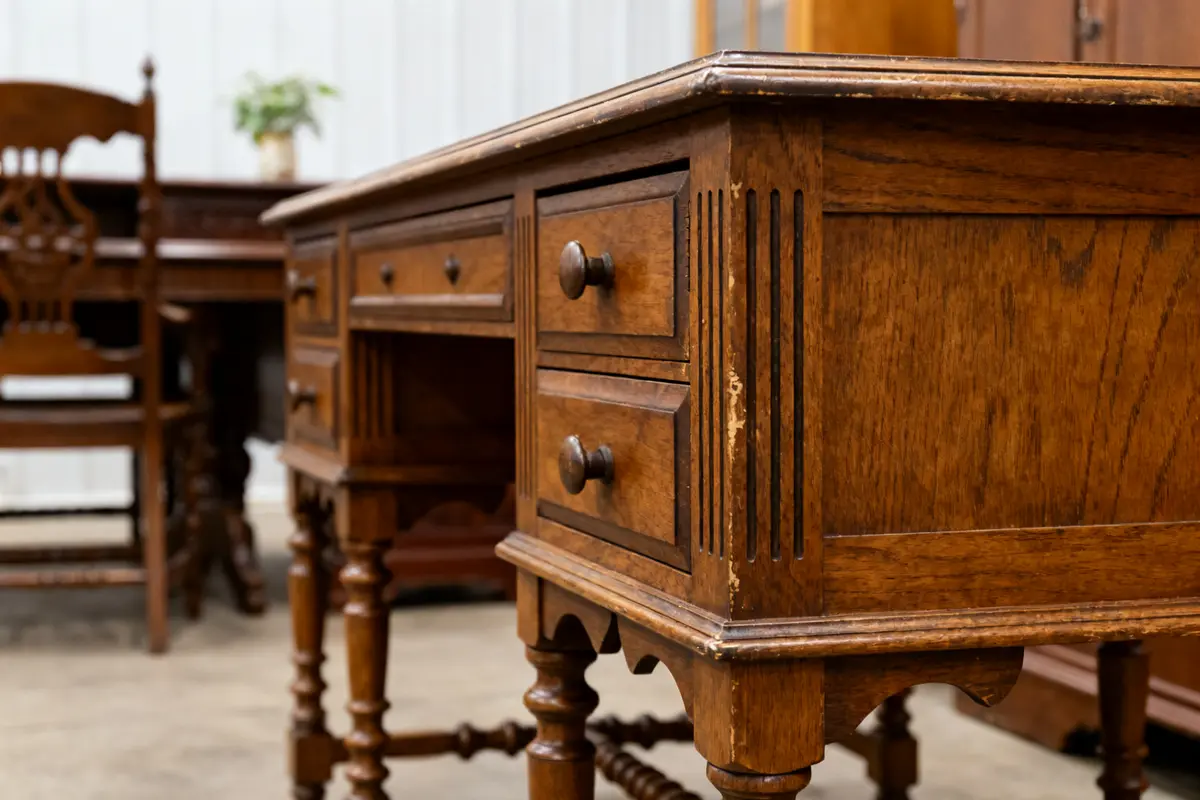
A defining feature of Eastlake furniture is its use of geometric ornaments and precise spindle work. Unlike the heavily ornate Gothic or Rococo styles that preceded it, Eastlake designs employ sharp angles, incised lines, and repetitive patterns that provide a sense of order and refinement.
Common motifs include sunbursts, quatrefoils, beveled panels, and notched squares. Spindle details often appear on chair backs, bedposts, and cabinet rails. Typical dimensions for an Eastlake dresser range from 4 to 5 feet in height and 3 to 4 feet in width, while chairs generally stand about 3 feet tall, making them practical for everyday use.
Wood, Finishes, and Craftsmanship
Eastlake furniture is most often crafted from oak, cherry, and walnut—woods prized for their durability and attractive grain patterns. The finish tends to highlight the wood’s natural texture, occasionally using ebonizing techniques for contrast despite Eastlake’s preference for richer wood tones.
Craftsmanship is a core trait of Eastlake design, combining machine-cut precision with hand-applied finishing touches. Surfaces are smooth and clean, with minimal dust-collecting carvings. The finishes are typically matte or satin, emphasizing honesty in materials and construction.
Author’s Note
« Look for the consistency of spindle spacing and the quality of incised carvings to verify authentic Eastlake craftsmanship—the balance of machine and handwork defines this style. »
Materials, Techniques, and Manufacturing
The production of Eastlake furniture merged traditional woodworking methods with emerging industrial processes. Craftsmen used steam-powered lathes to create turned spindles and employed jigsaw machines to form intricate fretwork details. This blend allowed for faster production without sacrificing decorative complexity.
Wood selection focused on sturdy hardwoods, often joined using mortise-and-tenon or dovetail techniques showcasing quality construction. Many Eastlake pieces maintain structural integrity well beyond a century. Decorative elements like beveled panels and incised linear patterns were commonly produced using carving routers after the main form was assembled.
Finishing methods emphasized longevity and ease of maintenance; the surface treatments resisted grime buildup and were designed for routine cleaning. This functional element helped popularize Eastlake furniture in households seeking both style and practicality.
Eastlake in America: Spread and Notable Homes
The United States embraced Eastlake style in architecture and furniture from the 1870s to the 1890s, especially in rapidly growing urban centers. Notable examples include elegant homes in California and New York that incorporated Eastlake detailing in both exterior woodworking and interior furnishings.
For instance, Queen Anne-style houses often displayed Eastlake spindlework in porch railings and gable trims. The John Bond Trevor Home in Yonkers, New York, features six exquisitely preserved Eastlake period rooms, offering a rare glimpse into the style’s domestic application.
Eastlake style also became prominent in middle-class homes, reflecting a desire for honest, artistic design. Its spread was propelled by national exhibitions and magazines, which showcased Eastlake furniture and inspired countless American manufacturers and consumers.
Collecting Eastlake: Identification and Care
Authenticating Eastlake furniture requires awareness of hallmark features. Genuine pieces exhibit precise spindle turning, consistent geometric carving, and high-quality wood finishes. Look for dovetail joints rather than nails or glue, as well as evidence that details were partly machine-cut and partly hand-finished.
Watch for reproductions that lack the crispness of original incised lines or employ modern materials. Distinctions can also be made through hardware: original Eastlake furniture often has brass or cast-iron handles with simple shapes rather than elaborate Victorian pulls.
Preserving Eastlake furniture involves avoiding harsh chemical cleaners and excessive moisture that can deteriorate wood or finishes. Dust regularly with a soft cloth and occasionally apply wax polish designed for hardwoods to maintain the patina and protect surfaces.
- Check spindle count and alignment for irregularities
- Inspect carvings for tool marks typical of 19th century craftsmanship
- Confirm wood type matches period preferences (oak, cherry, walnut)
- Protect finishes from UV rays and extreme humidity
- Use gentle cleaning methods to preserve original patina
🛠️ Eastlake Furniture Care Checklist
Use this checklist to maintain your Eastlake furniture’s condition and increase its longevity.
FAQ: eastlake furniture
What time period is Eastlake furniture?
Eastlake furniture dates back to the late 19th century, primarily from the 1870s to the 1890s. It reflects the design principles popularized by Charles Eastlake and became widespread in American homes during that era, coinciding with the Victorian period but favoring simpler forms.
Is Eastlake furniture valuable?
Eastlake furniture can be valuable, especially authentic pieces with quality craftsmanship and original finishes. Its value depends on condition, rarity, and provenance. Well-preserved examples from notable makers or historic homes often fetch higher prices among collectors and antique enthusiasts.
How to tell if furniture is Eastlake?
Furniture is identifiable as Eastlake by its geometric ornaments, precise spindle work, and incised linear carvings. Authentic Eastlake pieces show dovetail joints, consistent spindle spacing, and a mix of machine and hand craftsmanship, with finishes that highlight the wood’s natural grain.
What type of wood is Eastlake furniture made of?
Eastlake furniture is most commonly made from hardwoods like oak, cherry, and walnut. These woods were prized for durability and attractive grain patterns, and the finishes typically emphasize the natural beauty of the wood, often with matte or satin surface treatments.
What are the key features and motifs of Eastlake furniture?
The key features and motifs of Eastlake furniture include geometric ornaments such as sunbursts and quatrefoils, precise spindle work on chair backs and bedposts, beveled panels, and notched squares. The style emphasizes clean lines and subtle decorative details over heavy ornamentation.
How should Eastlake furniture be cared for and preserved?
Eastlake furniture should be dusted regularly with a soft cloth and cleaned using mild products like wax polish. Avoid harsh chemicals and excessive moisture. Maintaining moderate humidity and protecting finishes from sunlight preserves the wood and original patina for longer life.

John has been passionate about furniture and interior design for over a decade, combining his love for vintage pieces with modern styling techniques. After years of helping friends transform their spaces and restoring countless furniture finds, he started this blog to share his expertise and inspire others to create homes they truly love. When he’s not writing or hunting for unique pieces at estate sales, you’ll find him refinishing a mid-century dresser or experimenting with new room layouts in his own ever-evolving home.