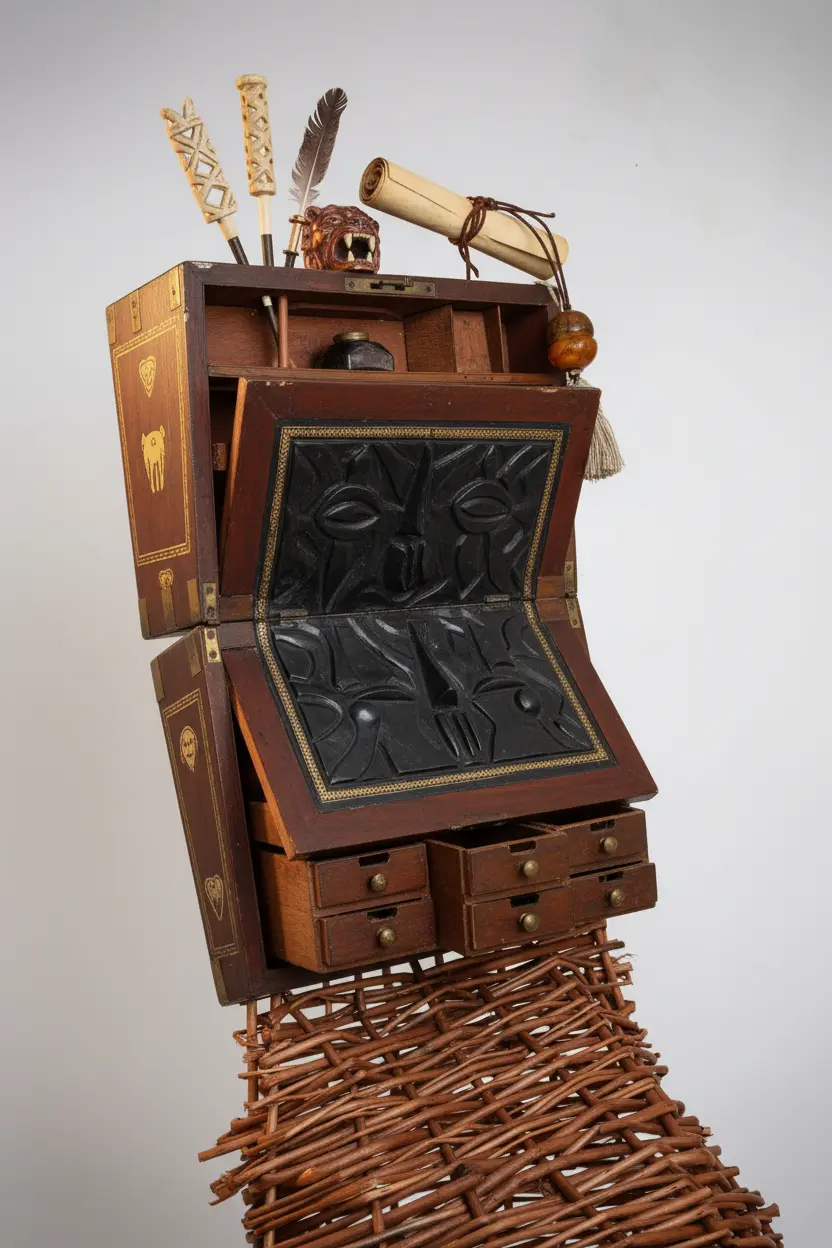
Think you’ve seen it all when it comes to sculpture? Think again. Sonia E. Barrett is here to shake up your expectations with her Desk series—hauntingly expressive art that fuses antique desks, steeped in colonial history, with the commanding features of African ceremonial masks. Yes, you read that right: the office staple meets rich African heritage, with a side of reclaimed wood and a whole lot of historical reckoning.
Colonial History, Carved Into Wood
When the subject of European colonization in Africa crops up, our minds often race to the era dubbed the Scramble for Africa—the mid- to late-1800s period when European powers, especially the British, French, Spanish, and Portuguese, raced to gobble up not just coastal communities, but the bountiful inland as well. Promises of untapped resources and economic gain beckoned them further, but let’s not pretend this scramble was the starting whistle. By the 1870s, Europeans already controlled about a tenth of the continent, primarily the north and areas along the Mediterranean and far south. Long before, as early as 1652, the Dutch East India Company had founded Cape Town, the first European settlement in Africa. And overshadowing the entire colonial enterprise was the grim machinery of the transatlantic slave trade—already a century old by Cape Town’s founding, and tragically set to continue for nearly two more centuries, during which 12.5 million or more Africans were forcibly shipped, mostly to the New World. That’s a lot of darkness hidden behind romanticized tales of “adventure.”
The Desk: From Colonial ‘Laptop’ to Platform for Resistance
Within that charged historical backdrop, the humble writing desk emerges as a silent witness. Back when colonists communicated only by hand, small, portable, wooden desks enabled them to send letters, record journals, and draft reports from almost anywhere—featuring clever fold-out surfaces (leather, of course!) and secret storage spaces for pens, nibs, and ink. Sonia E. Barrett sees these relics not just as curiosities, but as “the laptops of the day.” It was on these glossy surfaces that Europeans “wrote Africa” in accounts, dispatches, and communications—documents that now sit in European archives, shaping how the continent’s history has been told (and sometimes, let’s be honest, mis-told).
Barrett’s genius? She breathes new meaning into these desks, treating them as bridges to a time marred by greed, violence, and narratives shaped by colonial hands. By assembling her Desk series from Edwardian writing desks and an array of reclaimed materials—wood, leather, velvet, pens, ink, and wicker—she animates these tools with mask-like faces that channel the spirit and artistry of African ceremonial traditions. Her sculptures don’t just rest on the past; they challenge it. Barrett explains, “I thought (the desks) could be a way of speaking back to Empire beyond the archived letters written on them.” The message isn’t tucked away in a drawer; it’s right there in plain sight.
The Fusion: When Ceremonial Masks Meet Antique Desks
Masks have long been a cornerstone of diverse African cultures, each design shaped by local beliefs and traditions since, well, before written history. But as European ‘taste’ for these objects blossomed, the collecting craze gave rise to a lucrative art market—a phenomenon still alive and kicking. Interestingly, the raw materials converged: both the antique desks, typically from mahogany and sheathed in leather or velvet, and the masks—timber-based, often dressed up in leather. Barrett notes the somber reality: the mahogany used for desks matured in tropical climates, then was “shipped in much the same way as we were,” alluding powerfully to the shared fate of people and materials amid the international slave trade.
- Desks become mask-like heads.
- Wicker bases hint at shoulders and torsos—or can be loosely worn like ceremonial attire.
- Each piece is a potential conduit, a metaphysical transporter, pulling the viewer back through ancestral memory.
Barrett suggests these “heads” can quite literally join with African diasporan bodies, acting as vessels for collective memory—enabling today’s generations to reach back, just as their ancestors once did.
Experience the Conversation: Where to See Barrett’s Sculptures
Ready to see this daring artistic fusion up close? Some of Barrett’s Desk series sculptures form part of the exhibition The Ground Beneath: Material Memory and the Resilience of Hope at Messums London, running through November 15. For those who can’t make it to the gallery (or prefer art in pajamas), you can catch more about Barrett and her work on her website and Instagram.
In a world where history often whispers rather than shouts, Barrett’s sculptures ask us to listen closely—to reckon with uncomfortable pasts and unearth new connections. If you think you’ve seen every type of art out there, her Desk series politely begs to differ.

With a discerning eye for exceptional craftsmanship and timeless beauty, Edward has dedicated his career to sourcing and curating fine antique furniture from across USA. His deep appreciation for historical design, from Georgian elegance to Art Deco sophistication, guides collectors and enthusiasts in discovering pieces that tell stories of bygone eras. Through his expertise and genuine passion, he helps preserve the artistry of master cabinetmakers while bringing distinguished character into contemporary homes.