Discovering whether your vintage pottery is genuine or fake can save you hundreds of dollars and years of disappointment. Understanding roseville pottery ohio marks helps collectors naturally identify authentic pieces, avoid costly reproductions, and determine the true age and value of their finds. This guide reveals the secret marking systems that changed over sixty years, showing you exactly what to look for on your pottery’s base and how to spot the telltale signs that separate valuable originals from worthless copies flooding today’s market.
What are the roseville pottery ohio marks and how did they evolve?
Roseville pottery ohio marks are the identifying stamps, impressions, and molded markings found on the bottom of pottery pieces made by the Roseville Pottery Company in Ohio from 1890 to 1954. These marks changed dramatically over the company’s 60-year history, evolving from simple die-impressed marks to elaborate relief stamps that help collectors identify authentic pieces and determine their age.
The company’s marking system went through four major phases. Early pieces featured die-impressed marks stamped into wet clay before firing. Around 1905, wafer marks and arc stamps became common. The 1920s brought blue ink stamps with « Rv » lettering. Finally, from the 1930s onward, raised relief marks reading « Roseville U.S.A. » became standard.
Roseville pottery ohio marks timeline
The marking timeline spans six decades of American pottery production. From 1890 to 1905, most pieces carried die-impressed « Rozane » marks at the base. These early markings often appeared on utilitarian items like crocks and flowerpots.
Between 1905 and 1920, wafer marks gained popularity. These small clay discs bore « RPCo » or specific line names like « Egypto, » « Mara, » or « Woodland. » Arc stamps also emerged during this period, featuring curved text that rocked across the pottery’s surface.
The transition years of 1915 to 1928 saw the introduction of blue ink stamps. The simple « Rv » marking became increasingly common on art pottery lines. By 1923, this ink stamp system was firmly established for most decorative pieces.
The modern era began around 1932 when molded « Roseville U.S.A. » marks appeared. After 1937, these became raised relief marks, often accompanied by shape and size numbers like « 35-9 » or « 738-10. »
Roseville pottery ohio marks by era
Each era brought distinct marking characteristics that reflect changing manufacturing techniques and marketing strategies. The early period (1890s-1920s) emphasized functionality over decoration. Die-impressed marks were practical and durable, surviving the firing process reliably.
The art pottery movement influenced the middle period (1920s-1930s). Blue ink stamps aligned with the artistic nature of these pieces, appearing less industrial than impressed marks. This « Rv » stamp became synonymous with Roseville’s growing reputation for decorative pottery.
The late period (1930s-1954) reflected mass production techniques. Raised relief marks could be molded directly into pieces during forming, eliminating separate marking steps. Shape numbers helped organize an increasingly complex product line that included hundreds of different forms.
Key marks by Roseville line and era
Different pottery lines carried specific marking patterns that help collectors identify both the series and production period. Popular lines like Pine Cone, Donatello, and Water Lily each have characteristic mark styles tied to their production years.
Early art lines such as Rozane Royal and Rozane Woodland typically display die-impressed or wafer marks. These premium pieces often featured artist signatures alongside company marks, making them highly sought after by collectors today.
Mid-period lines like Baneda, Falline, and Ferella usually carry the blue « Rv » ink stamp. This marking system was standard from roughly 1923 to 1932, covering some of Roseville’s most artistic and valuable productions.
Later commercial lines including Magnolia, Snowberry, and Zephyr Lily feature the raised « Roseville U.S.A. » mark with shape numbers. These pieces represent the company’s final decades when production focused on mass-market appeal rather than art pottery exclusivity.
Different Roseville lines and their marks by era
Rozane and RPCo: early 1900s marks
The Rozane line launched Roseville’s transition from utilitarian pottery to decorative art pieces. Early Rozane pieces from 1900 to 1910 typically display die-impressed marks reading « Rozane » in block letters. These impressions were stamped into the wet clay base before the first firing.
RPCo wafer marks appeared on specialized lines within the Rozane family. Small circular clay discs were attached to piece bottoms and inscribed with « RPCo » or specific line names. Rozane Egypto pieces might show « Egypto » alone, while Rozane Mara carried « Mara » wafers.
Artist signatures frequently accompany these early marks. Talented decorators like Mae Timberlake and Virginia Adams signed their work, creating pieces that now sell for thousands of dollars at auction. The combination of company mark and artist signature indicates premium quality and authenticity.
Rv ink stamp and the rise of Roseville U.S.A. marks
The blue « Rv » ink stamp revolutionized Roseville marking around 1923. This simple stamping system allowed quick application to finished pieces before final firing. The ink burned into the glaze during firing, creating permanent identification that was difficult to fake.
Rv stamps appeared primarily on art pottery lines of the 1920s and early 1930s. Pieces from popular series like Baneda, Blackberry, and Cherry Blossom typically carry these blue ink markings. The stamps usually appear on unglazed areas of the base.
The transition to « Roseville U.S.A. » marks began around 1932 with indented relief impressions. These molded markings were pressed into the pottery base during forming. By 1937, raised relief marks became standard, creating the familiar elevated lettering found on most later Roseville pieces.
Shape and size numbers joined the relief marks after 1935. These numerical codes helped organize Roseville’s expanding product line, which included hundreds of different forms by the 1940s. A typical mark might read « Roseville U.S.A. 738-10, » indicating both the shape design and size variation.
Practical guide for collectors: how to read marks on your piece
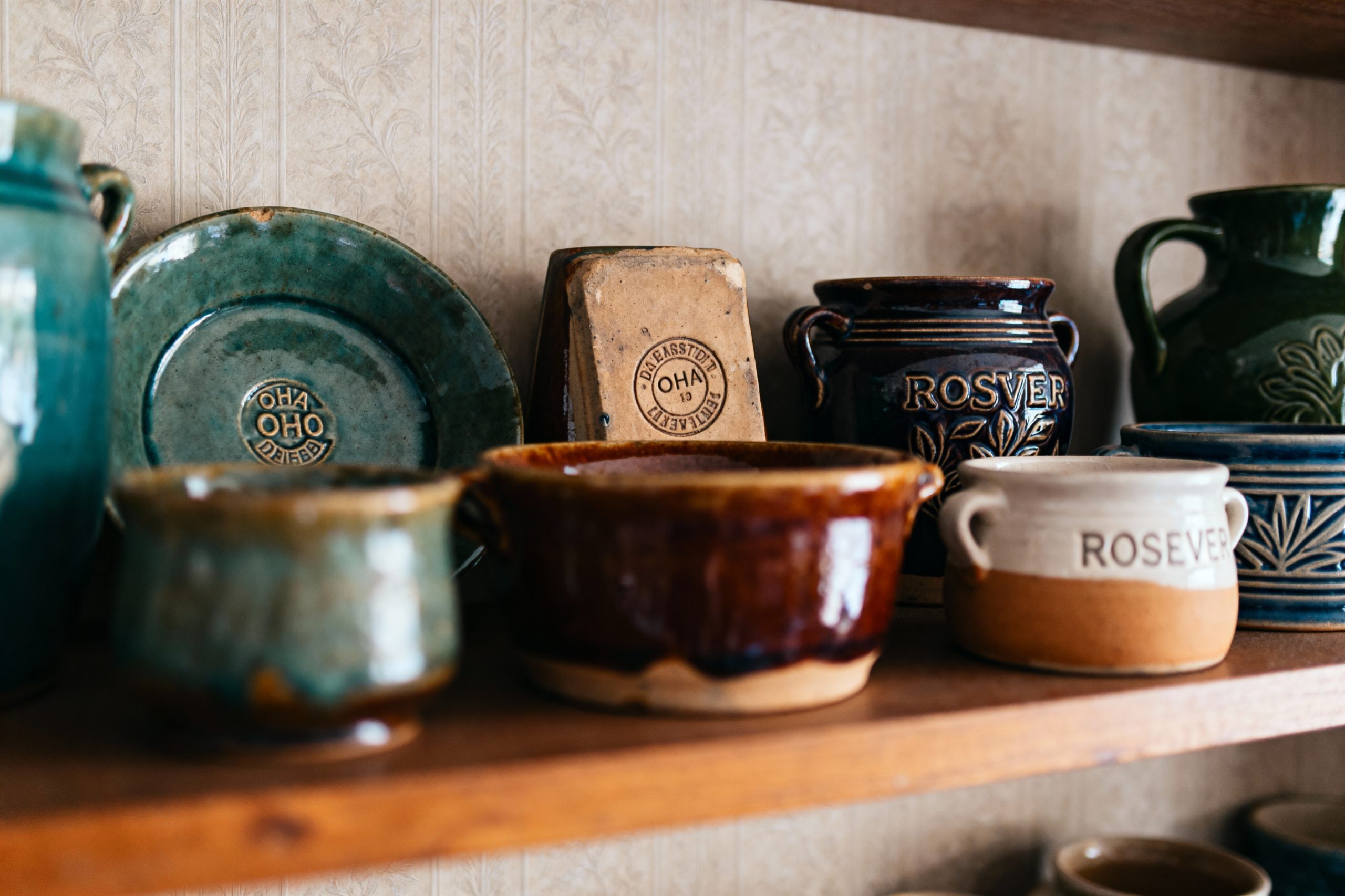
Reading Roseville marks requires careful examination of the pottery’s base. We recommend turning pieces upside down and examining the bottom surface under good lighting. Look for any impressed, stamped, or raised markings that might identify the piece.
Start by identifying the mark type. Die-impressed marks appear as indented letters or numbers pressed into the clay. Ink stamps show as blue or black lettering on the surface. Relief marks appear raised above the surrounding surface, often feeling bumpy to the touch.
Next, look for accompanying information. Shape numbers, size codes, and artist signatures provide valuable details about your piece. A complete marking might include the company name, line designation, shape number, size, and production era indicators.
Physical characteristics support mark identification. Examine the clay color, glaze quality, and overall construction. Authentic Roseville pieces display consistent craftsmanship, appropriate weight for their size, and glazes that match known color palettes for their production period.
Common marking locations include the center of the base, near the edge, or on unglazed ring areas. Some large pieces carry marks on the side or back surface. Take time to examine the entire piece systematically rather than focusing only on the obvious bottom center.
- Check the base center first, as this is the most common mark location
- Look for faint impressions that might be partially obscured by glaze
- Use a flashlight or bright lamp to reveal subtle markings
- Feel for raised areas that might not be visually obvious
- Examine unglazed areas where stamps are more likely to appear clearly
Spotting fakes and reproductions and how to verify authenticity
Reproduction Roseville pottery floods today’s market, making authentication skills essential for serious collectors. We estimate that reproductions account for roughly 30% of Roseville pieces sold online, with popular lines like Pine Cone and Magnolia being frequently copied.
Authentic pieces from 1937 onward always include « U.S.A. » in their relief marks. Any piece claiming to be late-period Roseville without this marking is likely a reproduction. Reproductions often display « Roseville » alone or use inconsistent lettering styles that don’t match genuine examples.
Physical characteristics reveal reproduction attempts. Fake pieces typically feel lighter than authentic pottery due to different clay compositions. The clay color often appears too bright or unnaturally uniform compared to genuine pieces, which show natural variation in tone.
Glaze quality provides another authentication clue. Reproductions frequently display overly bright colors, muddy tones, or glossy finishes that don’t match original Roseville glazing techniques. Authentic pieces show depth and complexity in their glaze application that mass-produced copies cannot replicate.
Handle construction offers a reliable test for many pieces. Reproduction handles tend to be thicker and clumsier than original versions. Authentic Roseville handles show proportional elegance and smooth attachment points that reflect skilled craftsmanship.
Mark placement and sharpness indicate authenticity. Genuine relief marks appear crisp and well-defined, positioned consistently with known authentic examples. Reproduction marks often show poor definition, incorrect placement, or missing elements like shape numbers.
We advise comparing suspicious pieces to documented authentic examples from reference books or museum collections. Shape numbers should match known production records, and overall proportions should align with established Roseville designs. When in doubt, consult experienced collectors or professional appraisers before making significant purchases.
Price can signal potential problems. Authentic early Roseville pieces with incised or wafer marks often sell for thousands of dollars, while reproductions typically sell for under $30. If a price seems too good to be true for a supposedly rare piece, additional authentication is warranted.
FAQ
What are the markings on Roseville Pottery?
The markings on Roseville Pottery include die-impressed, wafer, blue ink, and raised relief stamps. These marks evolved throughout the company’s history from simple impressions to detailed relief marks that help collectors identify authenticity and age of pieces.
What pottery is made in Roseville, Ohio?
The pottery made in Roseville, Ohio includes a variety of art pottery lines such as Rozane, Pine Cone, Donatello, and Water Lily. These lines showcased the artistic styles and trends of their respective production periods from 1890 to 1954.
How to spot fake roseville?
To spot fake Roseville, examine the markings, weight, and glaze quality. Authentic pieces have distinct relief marks, consistent craftsmanship, and specific weight. Reproductions often lack « U.S.A » markings, feel lighter, and have subpar glaze finishes.
What are the most valuable pottery marks?
The most valuable pottery marks often include those from early Roseville lines like Rozane and those with artist signatures. These marks correlate with quality and rarity, making them highly sought after by collectors in auctions and markets.
How can I find the mark on Roseville pottery?
To find the mark on Roseville pottery, turn the piece upside down and examine the underside in the unglazed area. Look for raised or imprinted marks, or old paper labels from the manufacturing period between 1927 and 1935.
Is Roseville pottery always marked?
Roseville pottery is not always marked. Many pieces produced between 1927 and 1935 had paper or foil labels that may be missing today. Some items were also made without any mark, making identification more challenging for collectors.

John has been passionate about furniture and interior design for over a decade, combining his love for vintage pieces with modern styling techniques. After years of helping friends transform their spaces and restoring countless furniture finds, he started this blog to share his expertise and inspire others to create homes they truly love. When he’s not writing or hunting for unique pieces at estate sales, you’ll find him refinishing a mid-century dresser or experimenting with new room layouts in his own ever-evolving home.